












School Committee at an impasse on future of budget
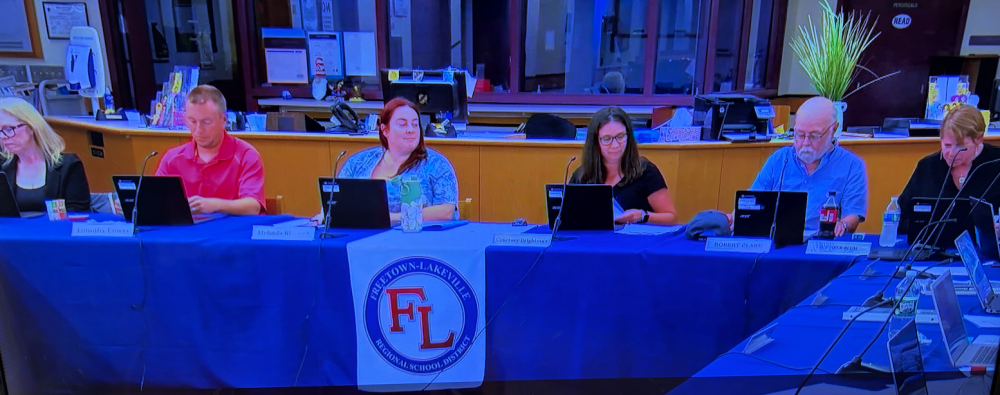 Freetown-Lakeville School Committee members discuss the next steps to take regarding the school budget. Photo courtesy LakeCam
Freetown-Lakeville School Committee members discuss the next steps to take regarding the school budget. Photo courtesy LakeCam
Freetown-Lakeville School Committee members discuss the next steps to take regarding the school budget. Photo courtesy LakeCam
LAKEVILLE -- Freetown-Lakeville Regional School Committee members could not decide July 29 on the next steps for the school budget that Lakeville voters rejected two days earlier.
Committee members instead voted to adjourn their meeting at Apponequet Regional High School and return at another date to reconsider the issue. No new meeting date was immediately set.
The decision to adjourn followed a lengthy discussion on whether the committee should accept Lakeville’s vote and move forward or call a joint town meeting with Lakeville and Freetown voters to take another vote.
Although the majority of committee members agreed to accept the reduced budget Lakeville voters approved, the vote did not receive the two-thirds majority to pass.
Lakeville Special Town Meeting voters on July 27 turned down a proposal to use $1.3 million from the town’s rainy day fund to make up the difference between the $350,000 voters previously approved toward the school budget and the $1.7 million increase the district was seeking.
Without the requested increase, about 60 staff members would be cut, administrators have said.
Committee members Kathryn Trost and Rebecca Cushing voted against accepting the budget approved by Lakeville voters. Committee member Timothy Emery abstained because a family member works for the district.
Yes votes came from Melinda Richards, Courtney Brightman, Jennifer Blum, Bob Clark and Derek Medeiros.
Much of the discussion prior to the decision to adjourn centered around the potential damage to the relationship between the schools and the town that could occur if the issue continued to be brought to voters.
“It’s very clear there are significant concerns in Lakeville regarding the school district,’’ Superintendent of Schools Barbara Starkie said. Perhaps the time has come, she stated, to “repair the relationship with the two towns.’’
Committee chair Richards said her committee had “put up a good fight’’ to bring a higher budget to the communities. But voters have spoken, she said, and “continuing this fight’’ could “cause more destruction than benefit.’’
With no budget in place, the schools are operating on a month to month basis based on their current numbers. Director of Finance John Higgins noted that carrying on with this form of budgeting could “create difficulty making payments further on down the road’’ particularly because large payments such as those to retirement accounts and insurance are made in the early portion of the budget year.
With Lakeville’s rejection of the budget, the committee could accept the amount approved by Lakeville or call for a joint town meeting with voters in Lakeville and Freetown.
If the joint town meetings rejected the budget, the Department of Secondary and Elementary Education would step in and set a budget. What this budget would be is not known, Higgins said, but he noted that towns would struggle to work with a higher number later in the year.
Freetown voters accepted the requested school budget although some school committee members noted that the Town Meeting that approved the school spending also included other items that might have brought out voters. A vote strictly on the school budget would likely draw less support for the schools, committee members said.
Cushing noted that, although that could be the case, Freetown did support the budget and “I’d like them to have the opportunity to come to the table.’’
Trost said she took an oath to the students. “We will not recover from 60 positions eliminated,’’ she said.
Another potential issue regarding a joint meeting, committee members said, is that a majority of the school committee would have to agree on what figure to present to those voters. Committee members could not agree on that number at their July 29 meeting.
Richards also noted that, based on Starkie’s calculations, about two-thirds of the laid off staff members have found new positions elsewhere. Hiring new people so close to school opening on Aug. 31 would be a challenge, the superintendent said.
Committee member Blum said she was “really disappointed’’ with the budget rejection. But she said the sense is that the committee is “not going to have the support’’ they need and “we’re going to drag this out.’’
The towns may not recognize the true impact until they see students in larger class sizes and potentially struggling, she said. When that happens, she said, residents might view the situation differently.
Richards said that some school families may not even be aware of what is happening. “More parents need to come out and vote,’’ she said.