











Free-Lake school district fights for funding, town officials prepare for $2.5 million budget shortfall
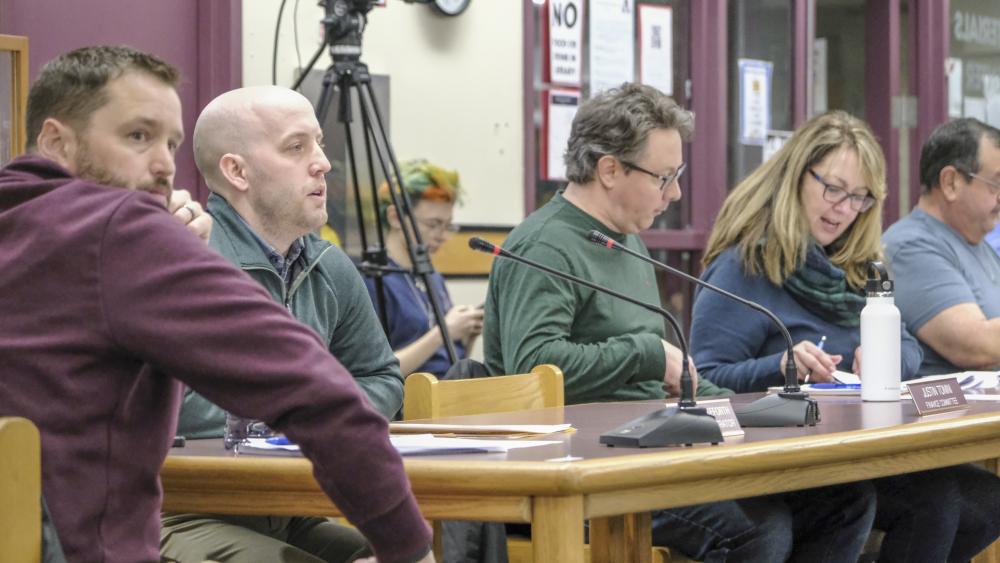 From left: Finance Director Mike Ellis and Town Administrator Andrew Sukeforth seen at the March 5 meeting. The meeting saw large attendance as officials considered future budget shortfalls.Photos by Sam Tucker
 The joint meeting brought the Select Board, district leaders and school committee members to review the needs of the district, and how it can be funded.
 Interim Superintendent Barbara Starkie, right, presents the district's proposed budget. She outlined that major cuts would have to be made if the district isn't properly funded.
From left: Finance Director Mike Ellis and Town Administrator Andrew Sukeforth seen at the March 5 meeting. The meeting saw large attendance as officials considered future budget shortfalls.Photos by Sam Tucker
The joint meeting brought the Select Board, district leaders and school committee members to review the needs of the district, and how it can be funded.
Interim Superintendent Barbara Starkie, right, presents the district's proposed budget. She outlined that major cuts would have to be made if the district isn't properly funded.
Interim Superintendent Barbara Starkie, right, presents the district's proposed budget. She outlined that major cuts would have to be made if the district isn't properly funded.
From left: Finance Director Mike Ellis and Town Administrator Andrew Sukeforth seen at the March 5 meeting. The meeting saw large attendance as officials considered future budget shortfalls.Photos by Sam Tucker
The joint meeting brought the Select Board, district leaders and school committee members to review the needs of the district, and how it can be funded.
Interim Superintendent Barbara Starkie, right, presents the district's proposed budget. She outlined that major cuts would have to be made if the district isn't properly funded.
LAKEVILLE — As Lakeville faces a $2.6 million deficit in next year’s budget, town officials are considering raising property taxes above the typical annual increase.
Raising taxes would mostly fund the FreeLake school district, with town Finance Director Mike Ellis estimating Lakeville’s contribution at around $1.8 to $1.9 million next year. The other portion of the deficit stems from an increase of $570,000 for fixed costs for the town, which covers necessary spending such as health insurance, pensions and liability insurance.
After lengthy discussion at a March 5 joint meeting with the school committee, Select Board and Freetown town officials, the Lakeville Select Board decided to vote on approving a tax override at its March 17 meeting.
Town Administrator Andrew Sukeforth said the town will collect roughly $750,000 in tax property revenues for next year’s budget under the state-imposed limit of Proposition 2 ½.
Proposition 2 ½ sets a “ceiling” for the total annual revenue raised from taxes. Towns can’t raise taxes more than 2.5% over the previous year’s limit — which includes tax revenues from new developments — without voter approval.
Since raising taxes at the 2.5% rate will not cover the roughly $2.6 million deficit, the town can ask voters for permission to permanently raise their taxes higher through an operational tax override.
If voters don’t pass the override, Sukeforth said the school district would have to cut the budget by about $1.8 million and the town would have to cut about $700,000 in personnel and operational expenses.
During a presentation at the joint meeting, FreeLake district representatives said they need to increase next year’s budget by $3.7 million — about 7.5% — compared to the current budget.
FreeLake Interim Superintendent Barbara Starkie and Finance Director Jack Higgins said the budget increases largely come from staffing, health insurance and computer replacement and fire suppression upgrade costs. Changes in state aid and use of leftover funds from the current budget have also strained the district’s budget.
The main goal of this “level-service” budget, Starkie said, is to maintain the services the school currently provides students. She said if the budget isn’t funded, 50 positions across the district would be cut and programs would be reduced.
“I think the people in the communities should be the ones making the choice,” Starkie said. “I just simply ask [the Select Board] to consider allowing them that voice through an override.”
Ellis and Town Administrator Andrew Sukeforth said the town can fund the district’s budget either through a tax override or cuts to an already “shoe-string” budget.
Sukeforth said even if taxes are raised, the town could face a similar deficit at the end of next year’s budget.
“There's a lot of work for us to do to make the options more efficient and make them last,” Sukeforth said.
Sukeforth said fixed costs for the town and schools will continue to rise. He said the town’s costs outpace the “stagnant” revenues because the town can’t raise enough money through taxable new developments or the 2.5% property tax rate.
“New growth is how a lot of towns get by with budget issues. They have a lot of new construction going on, and we don't,” Sukeforth said.
Ellis said a $4 million or $6 million tax override would provide stability and fund the district for several years, but would place a “huge burden” on taxpayers.
Without increasing taxes, addressing the shortfall would be “painful,” he said.
“We have cut everything we could possibly cut. We would have to get very creative, if not make [more] cuts,” Ellis said.
Sukeforth said every $1 million in overrides equals about $200 in property tax increases for the average home in Lakeville.
The last override Lakeville voters passed was in 2014, where they approved raising taxes to come up with $1.5 million to fund the Free-Lake district operating budget.
Similar to the Old Colony debt-exclusion vote, a special election would be held for voters to approve or deny the move, Sukeforth said. The special election would most likely come before the Annual Town Meeting in May, where voters would decide whether to give final approval for the override.
Sukeforth said he and Ellis will most likely provide multiple override options for the Select Board to vote on. More specific plans will be shared at the March 17 Select Board meeting.
Public speaks out
Dozens of students, teachers and residents filled the Apponequet Regional High School library for the March 5 meeting.
The crowd erupted in applause throughout the meeting as school officials and residents spoke on the importance of proper funding and maintaining services for students.
Jeremy Mare, a science teacher at Apponequet, said maintaining services is a necessity — not an expansion or luxury — and cuts would be detrimental to students.
“I urge you to provide level-service funding for this district and to stand behind the students, families and educators who work every day to make the district something our communities are proud of,” Mare said.
Kevin Murphy, also a high school science teacher, echoed the importance of maintaining services.
“It breaks my heart to see that there might be a time when [young] students might come up and those opportunities that are currently here for these students are gone,” Murphy said.
Science teacher Kyle Marshall said cuts could impact Apponequet’s graduation rates.
“If we do not meet this budget, this school and lots of the resources will finally be cut to the point where we will start dropping off,” Marshall said.