











Philip Arthur Burrage, Jr.
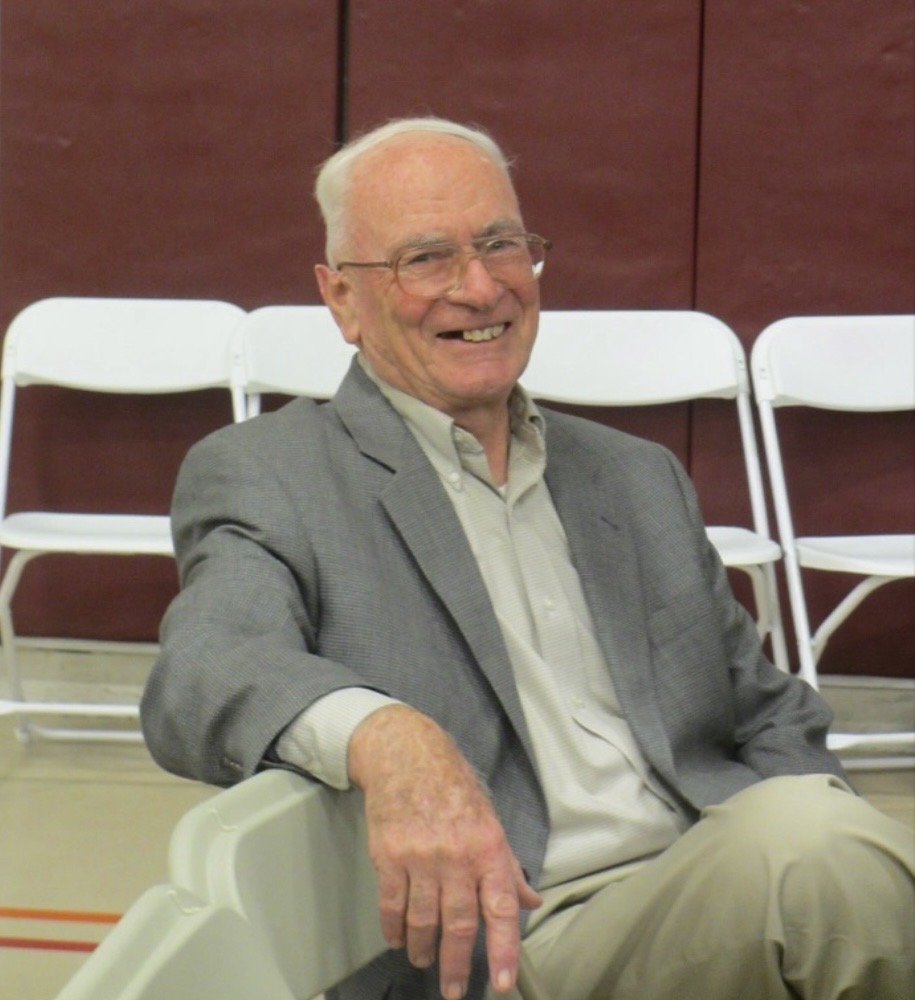
Philip Arthur Burrage, Jr., April 12, 1930 to February 2, 2026
Philip was the son of the late Edith May Casey of Brookline and Philip Arthur Burrage Sr. of Weston. He was born in Cambridge (Mount Auburn Hospital) and lived for a time at 17 Alden Street in Watertown, before moving to his ancestral home in Weston during the Great Depression when his father lost his business (Smart Curtain Company in Boston). The family eventually settled down more permanently in South Weymouth.
Phil loved his Pleasant Street, Weymouth hometown. In spite of losing his mother to heart disease when he was just fourteen, he had an idyllic upbringing there, playing baseball and hockey with his best friends’ Bob Smith, Ted Williams and Bobby Sprague, grabbing soda pops at Poole’s corner store, and taking in double features at the Cameo Theater.
As a child, Phil was too young to serve in World War II. Thus, he did what perhaps other teen age boys did during those years—he compiled newspaper scrapbooks of the war, read every book he could get on Winston Churchill, and accompanied his aunt Estelle (his future step-mother) to USO canteens. Phil became an airplane spotter in South Weymouth during the war. His father, Philip Sr. had served as a Corporal in the 26th Yankee Division of the 101st Engineers during the Great War, and had taught his son how to identify allied and enemy planes. Father and son regularly manned the South Weymouth Air Station tower on weekends. Phil Jr. also accompanied his dad, an air raid warden, around the neighborhood, ensuring that people closed their drapes and shut off their lights when the sirens blew.
Phil graduated from Weymouth High School in 1948, winning that school’s prestigious history prize, and attending Boston University School of Business Administration. Just after college graduation, Phil enlisted in the United States Army and served stateside as a medic in the Dental Corp for two years during the Korean War.
Phil was raised in a staunchly Republican household, and yet, as he traveled south during his tour of duty, he witnessed segregated bathrooms and other forms of discrimination, leading to a crisis of conscience, and a quest for knowledge. He become a Democrat during the Civil Rights Era, and his political loyalties became increasingly liberal as his humanitarian sensibilities broadened throughout his long life.
Ever the political scholar, Phil read voraciously. He devoured non-fiction history and political biographies, filling his home with walls of books. He was a student of the Holocaust, and spent weekends and evenings watching World War II documentaries, learning as much as he could about this brutal era in world history. He was fascinated by Watergate, and was glued to the TV during that period. In his later life, he watched the Trump era unfold with even greater horror, and he turned from witness to activist, attending the Plymouth National Day of Mourning rally on Thanksgiving 2023 and a Boston “No Kings” rally in 2025.
Phil loved jazz music. He often talked fondly of driving his 57’ Chevy around metro-Boston cranking the radio to the sultry horn of Bunny Berigan’s I Can’t Get Started or Doris Day’s Autumn Leaves. He often regaled his children with stories of dancing at the Totem Pole Ballroom at Norumbega Park in Auburndale, Taunton’s Roseland Ballroom, and Moseley’s on the Charles in Dedham, where he would see artists like Duke Ellington, Benny Goodman and Les Brown perform.
After the military, in spite of his desire to become a history professor, Phil dutifully followed his father into the manufacturing field, working in various managerial roles at Robertson Factories in Taunton and Middleboro for the entirety of his career. It was at this company where he met Marilyn E. Procknik, whom he married in 1958, moving to a cozy 1950’s split-level home in Middleboro that they transformed into a replica of the pre-Revolutionary-era Hell’s Blazes Tavern of Middleboro (circa 1690), complete with gunstock beams, rough-hewn paneling, and a large English brick fireplace. One would often find Marilyn and Phil in their wingchairs reading history books by a roaring fire.
Family meant everything to Phil. He was an incredibly supportive dad and granddad. Not only a stable and strong financial provider, he was the emotional backbone of his family as well. Phil had a big and open heart. He was an active listener, and would offer wonderfully kind and inciteful guidance. He was the family groupie---enthusiastically applauding his wife, children and grandchildren’s musical, theatrical, academic and professional endeavors. He quietly supported his extended family as well, guiding his son Scott and nephew Don Sprague as they learned to pilot their grandfather’s Lyman on Bass River; attending nephew Wayne Procknik’s football games; or taking the boys to demolition derby races.
Ancestry really mattered to Phil, and he took his responsibilities seriously, bringing family history to later generations. When he inherited the Burrage family homestead in Weston, he could have cashed it in for a more comfortable retirement, but he immediately gifted the property to his daughter and her husband, so that the family legacy would continue. His children and grandchildren came to know deceased ancestors through his often-told stories, becoming intimately connected to these relatives whom they had never met. Before he passed, and with diminished memory, he asked his daughter to tell him bedtime stories of these ancestors, which seemed to give him great comfort.
Phil enjoyed spending time outdoors in nature, particularly beneath the pine trees of his three acre property in Middleboro. He worked exhaustively in his backyard, raking, mowing, and pruning the yard to make a park-like setting. When his children were small, he set up an old army tent in the backyard for his children to play in. Years later, he enlisted his fifteen year old son Scott to help him clear brambles in a wooded section of the yard, and after they had finished, he rewarded his son with a used car, and a new place where the unlicensed boy could practice driving.
Phil loved spending time at his summer home on Bass River, Cape Cod, a property his parents had purchased in the 1950s. He loved the spectacular sunsets, watching the boats go by, seeing the ducks fly overhead in a V-pattern, and pointing out the swans on the river. He paid close attention to changing weather patterns, high and low tides. He was a sucker for a hurricane, and would take days off from work to witness the storms. Phil loved camping. His children and grandchildren have fond memories of times with him in areas 3 and 4 at Nickerson State Park. After he passed, his grandson Ray, found pine needles in his old coat pocket, likely mementos from that period.
Phil loved New England, and had a strong sense of place. He was spiritually connected to the region through seventeen generations of ancestors who preceded him. He loved reading the poetry of Robert Frost, Donald Hall and Stanley Kunitz. He enjoyed learning about the Colonial era history of New England, and he could imagine what the region’s landscape looked like in that earlier time. In recent years, he appreciated learning about the less celebratory history of his Puritan ancestors and their culpability in the Witch Trials, the Slave Trade, and their exploitation of Native land and peoples. He benefitted from Covid era Zoom lectures, as well as recent visits to the Robbins Museum of Archaeology and the Concord Museum, which broadened his knowledge.
In addition to being a smart and introspective man, Phil was the heart and soul of the Burrage family, a gentle man in the truest sense, easy going and with great wit. He always tried to see the lighter side of life, even as the heaviness of his later years bore down. He left an indelible mark on his family and anyone who knew him.
He is survived by his son Scott E. Burrage of Middleboro and Mexico (husband Gerardo Flores) and daughter Dr. Melissa D. Burrage of Weston and South Dennis (husband Thomas J. Goodwin); his grandchildren, Lydia Burrage-Goodwin of Weston, Zachary Burrage-Goodwin (now deceased) and Ray Burrage-Goodwin of Ottawa; his sister, Linda Sprague of California (William), nephew Don Sprague (Val) of California, niece Kathryn Sprague of California, and niece Sharon Thomsen (Mark) of Montana, and their families; two cousins, Estelle Marshall of Pennsylvania and Ron Cheney (Judy) of New Hampshire, and their families; sister-in-law Beverly Procknik of Raynham, niece Julie Sprague (Kevin) of Dighton and nephew Wayne Procknik (Donna) of Lakeville, and their families; niece Kristin Hebert of Taunton; and a wonderfully supportive group of Marilyn’s cousins from New Brunswick, Canada. Phil is also survived by his dear Middleboro neighbors Scott Winslow and Tomas Gomez, whom he viewed as family.
Philip was cremated at Mount Auburn Cemetery in Cambridge, where his great grandfather and many other ancestors are buried. He will be laid to rest in springtime (with Marilyn) at the Linwood Cemetery in Weston, in the old Burrage family plot. His family will continue to think of him sitting in his easy chair, fast asleep, book on his lap, still tapping his toes to some Big Band tune.